Tag Archives: Hermeneutics

Review of Amr Osman, The Zahiri Madhhab

Here is my review of a new book on the Zahiri school of law, commonly called “literalist” but better described as “textualist” according to Amr Osman. Unfortunately, I found that the book suffers from numerous problems, which are documented in the review.

David R. Vishanoff. Review of Amr Osman, The Ẓāhirī Madhhab (3rd/9th–10th/16th Century): A Textualist Theory of Islamic Law (Leiden: Brill, 2014). Der Islam 93 no. 2 (2016): 603–609.

Permanent link to the published article (Version of Record): DOI 10.1515/islam-2016-0047

Given the negative nature of the review, I do not wish to distribute it widely, and so will not post the full text here. It is important only for those scholars who are considering making serious use of Osman’s book.

The anthropological turn in Islamic legal interpretation

On July 23-24, 2016, the Zentrum für Islamische Theologie at the University of Tübingen did a superb job of organizing and hosting a conference on “Islamic Theology – Past, Present and Future: Global Challenges and Prospective Synergies in the Academic Study of Islam.” My presentation dealt once again with the Indonesian thinker Aksin Wijaya, arguing that his explicitly anthropocentric epistemology reflects a broader shift in Islamic thought that opens up new conversations between historical and confessional scholarship on Islam:

“The Anthropological Turn in Islamic Legal Interpretation.” Islamic Theology – Past, Present and Future: Global Challenges and Prospective Synergies in the Academic Study of Islam, University of Tübingen, July 24, 2016.

Here is a pdf of the paper, as delivered. It was written for oral presentation, without documentation. I plan to use it as the framework for a published article incorporating aspects of several papers I have given recently on Qur’anic hermeneutics in contemporary Indonesia.

Article on al‑Shāfiʿī’s hermeneutics: الهرمنيوطيقا الفقهية عند الإمام الشافعي

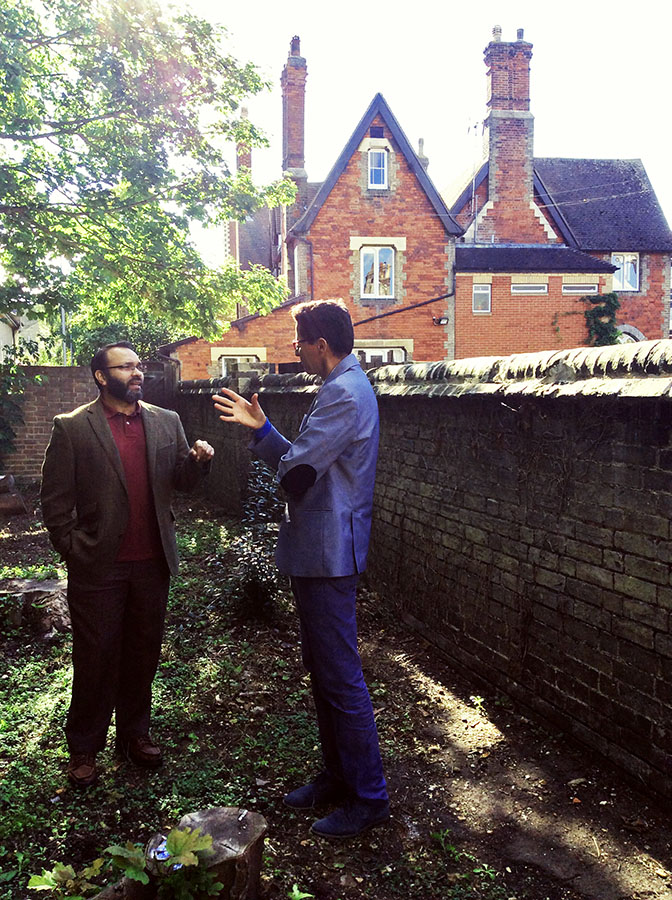
This Arabic article on the legal hermeneutics of al‑Shāfiʿī was presented at a regional meeting of the Nahdlatul Ulama in Yogyakarta, Indonesia in 2013, and then published in a journal edited by my host Dr. Sahiron Syamsuddin (with me in the picture above):

David R. Vishanoff. “Al‑hirminyūṭīqā al‑fiqhiyya ʿinda al‑Imām al‑Shāfiʿī.” International Journal of Pesantren Studies 7 no. 2 (2015 [2016]): 263–281.

Here is a pdf of the article (marked up to indicate a few corrections necessitated by formatting issues).

Here is the English abstract:

Hermeneutics is not a new discipline among Muslim thinkers; it goes back to al‑Shāfiʿī’s founding of the discipline of legal theory (uṣūl al‑fiqh). This article examines the role al‑Shāfiʿī played in the founding of Islamic legal hermeneutics, and then describes his hermeneutic as one of great flexibility for defining hermeneutical intertextual relationships, and great freedom for deriving legal rules from texts. Then it presents the goal of al‑Shāfiʿī’s hermeneutic as the establishment of a perfect correlation between his legal opinions and the Qurʾānic verses and Prophetic traditions that were widely accepted in his time. Then it indicates the most important consequence of al‑Shāfiʿī’s legal hermeneutic: the possibility of imagining a legal system that is at once divine and human, that is entirely based on the texts of divine revelation yet also evolves to suit the needs of human society across time and space.

Can Qur’anic Interpretation Be Both Practically Adequate and Theologically Principled? Some Instructive Historical Examples…

Harith Bin Ramli and Ramon Harvey hosted a warm, lively, and coherent symposium on theologies of revelation at the Cambridge Muslim College. It was a beautiful and memorable day, epitomized by this image of Shahrur and Mohammed:

Sahrur and Mohammed at CMC symposium

My presentation was a reflective pause, looking back on my previous work on classical legal hermeneutics, drawing in my recent readings in Indonesian Qur’anic hermeneutics, and pondering some of the intellectual challenges and moral dangers of thinking systematically about revelation:

“Can Qur’anic Interpretation Be both Practically Adequate and Theologically Principled? Some Instructive Historical Examples of the Delicate Connection between Hermeneutical Theories and Doctrines of Divine Speech.” From Revelation to Scripture: A Symposium on Divine Speech and Prophetic Inspiration in Islam, Cambridge Muslim College, Cambridge, England, September 12, 2015.

The new material in this paper about the Indonesian thinker Aksin Wijaya was previously discussed at the International Qur’anic Studies Association in 2014. This paper was not published, but a revised and expanded version will be presented at a conference on “Dynamics of Tradition: Islamic Theology and Law in Relation” at the University of Paderborn, September 19, 2021, and will hopefully be published in a volume of essays from that conference.

Another image from the day–Farrokh and Ramon during one of the many coffee breaks:

Farrokh and Ramon at CMC symposium

Hermeneutics and the Traditional Islamic Sciences in Indonesia Today

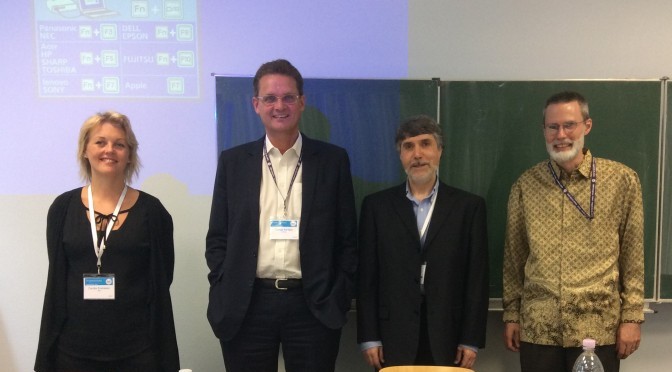
At the IAHR meeting in beautiful Erfurt, in a paper session organized by Carool Kersten on “Retraditionalisation, Anti-Foundationalism and Glocalisation in a Post-Islamist Muslim World,” I presented a simple comparison of three Indonesian thinkers whose works I had been reading, and whom I had just had the opportunity to interview in Indonesia:

Hermeneutics and the Traditional Islamic Sciences in Indonesia Today: Rhetoric, Retraditionalisation, or Creative Anti-Foundationalism?” International Association for the History of Religions, Erfurt, Germany, August 24, 2015.

Here is a link to a pdf of the paper as presented. This is an oral presentation version, without documentation. It is not intended for publication, though the figures discussed here will doubtless appear in some future publication.