Tag Archives: Hermeneutics

Five Facets of the Anthropological Turn in Qur’anic Hermeneutics

Majid Daneshgar and Johanna Pink, of the University of Freiburg, invited me to participate in their online lecture series “Freiburg conversations on tafsir and transregional Islamic networks II,” and Nadja Germann, also of the University of Freiburg, served as host and gave a very helpful and thought-provoking response that will reshape the outline of my long-term project on contemporary Qur’anic hermeneutics. Questions from the audience, starting with Karen Bauer, are also pushing me to rethink my starting point: should I start with the classical and modern sources of hermeneutical ideas, or with the thinkers who appeal to those classical and modern sources, or with the ideas themselves? Should I work chronologically or thematically? Up or down the isnads of intellectual transmission and exchange? The discussion really got me thinking.

“Five Facets of the Anthropological Turn in Qur’anic Hermeneutics: History, Linguistics, Ideology, Phenomenology, and Postmodernism.” Freiburg conversations on tafsir and transregional Islamic networks II, via Zoom, March 3, 2021.

There were no slides, but the full text of the talk is available here as a pdf. Video of both the talk and Nadja’s response (but not the Q&A) is available on YouTube here.

Informative and Performative Theories of Divine Speech in Classical Islamic Legal Theory

This paper, delivered in 2017 at the conference on “Intention and Signification: Philosophy of Language Across Islamic Disciplines, 800-1200” organized by Nadja Germann at the University of Freiburg, has been published in the conference volume:

David R. Vishanoff. “Informative and Performative Theories of Divine Speech in Classical Islamic Legal Theory.” In Philosophy and Language in the Islamic World, ed. Nadja Germann and Mostafa Najafi, 183–208. Philosophy in the Islamic World in Context, ed. Peter Adamson, et al., no. 2. Berlin: De Gruyter, 2021. https://doi.org/10.1515/9783110552409-007

The volume is available from De Gruyter.

Abstract: The Qurʾān describes God’s speech as powerful and creative: “When he decrees something he merely says to it ‘Be!’ and it is.” Just as impressively, when he desires to make an action obligatory he merely says “I oblige you to do it,” or even just “do it!” This is an example of what some modern theorists of language call performative speech, which brings about a new state of affairs rather than just conveying information about what is already the case. This essay considers the emergence of the concept of performative speech in classical Islamic legal theory, presenting the debate over whether to regard God’s speech as informative or performative as part of an ongoing argument over the nature of law, the nature of God’s speech, and the relationship between them. After a brief discussion of Muḥammad ibn Idrīs al-Shāfiʿī (d. 204/820), the essay presents the views of four contrasting thinkers of the late 4th/10th and early 5th/11th centuries: the Shāfiʿī jurist and Muʿtazilī theologian ʿAbd al-Jabbār (d. 415/1025), who treated God’s speech as a purely informative description from which human beings may deduce the details of an ontologically and epistemologically prior moral order; the Ḥanbalī Abū Yaʿlā Ibn al-Farrāʾ (d. 458/1066), who took the opposite tack, treating God’s speech as a performative speech act that brings about obligations with the immediacy of a master’s face–to–face orders to a slave; the Mālikī jurist and Ashʿarī theologian Abū Bakr al-Bāqillānī (d. 403/1013), who sought to have it both ways; and the Ḥanafī Abū Zayd al-Dabūsī (d. ca. 430/1038), who appears to have introduced the term inshāʾ into Sunni legal theory. These last two thinkers sought, in very different ways, to affirm that legal obligations are brought about by God’s speech; yet they treated the language of revelation as a source of information and indicative evidence from which human interpreters could reconstruct the law through a flexible interpretive process.
Uṣūl al-Fiqh versus Hermeneutics

Detail of wall in the ornate meeting room

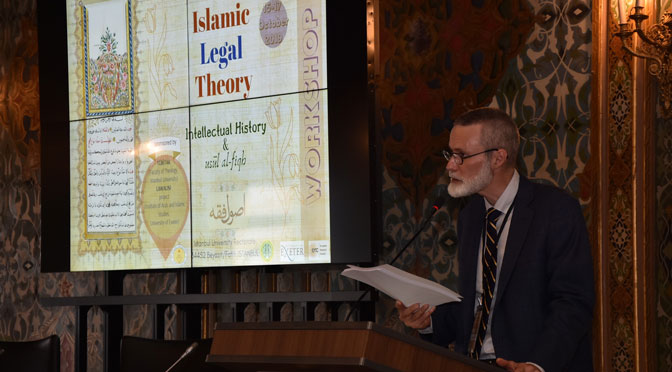
Many thanks to Rob Gleave and Murteza Bedir for organizing another great conference on Islamic legal theory in Istanbul, and to all the participants for rich conversations and for helpful feedback on my paper, which was:

“Uṣūl al-Fiqh versus Hermeneutics: History, Linguistics, Ideology, Phenomenology, and Postmodernism between Europe and Indonesia.” Conference on “Islamic Legal Theory: Intellectual History and Uṣūl al-Fiqh,” Istanbul University, October 15, 2019.

Here is a pdf of the pre-conference draft of the paper that was shared with participants. It is complete but lacks documentation, so please do not cite it formally yet; it has since undergone significant revision and has been submitted for publication in the conference volume, which we hope will be published in 2022.

Conference participants
The conference participants
Detail of wall in the ornate meeting room
View of the Süleymaniye mosque from the meeting room

European and Islamic Contributions to an Anthropocentric Qur’anic Hermeneutic

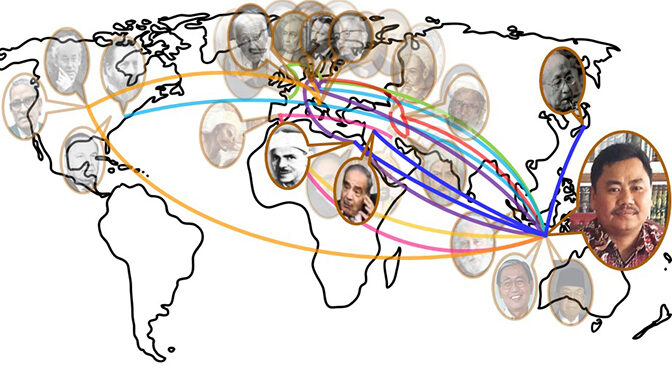
Mehdi Azaiez and the staff of Beit al Hikma (Académie Tunisienne des Sciences, des Lettres et des Arts) put on a stimulating conference in Beit al Hikma’s beautiful home in Carthage, right on the Mediterranean. Over the course of three days (July 4-6, 2017) a full-throated debate played out, in three languages, over the context within which the Qur’an ought to be read. My own contribution traced the main currents of European philosophy and Islamic thought that made their way into one Indonesian thinker’s call for an anthropocentric reading of the Qur’an:

“An Anthropological Turn in the Qur’anic Sciences: European and Islamic Contributions to Aksin Wijaya’s Indonesian Hermeneutic.” Conference on “Qur’anic Studies: Methods, Contexts, and Interpretations,” International Qur’anic Studies Association and Beit al Hikma, Carthage, Tunisia, July 4, 2017.

The slides from my presentation, which trace the connections between thinkers across a world map, are available here. The text of the paper is still too rough to post here, but I plan to turn it into an article within the next year.

Indicative and Performative Theories of Divine Speech in Classical Islamic Legal Theory

Nadja Germann and her research team put on a very rich and remarkably focused conference on “Intention and Signification: Philosophy of Language Across Islamic Disciplines, 800-1200” at the University of Freiburg, in beautiful Baden-Württemberg, Germany, from June 1 to 3, 2017. What a feast! My own contribution was:

“Indicative and Performative Theories of Divine Speech in Classical Islamic Legal Theory.” Intention and Signification: Philosophy of Language Across Islamic Disciplines, 800-1200, University of Freiburg, June 3, 2017.

The paper has now been revised and published in the conference volume from De Gruyter.