Tag Archives: General Islamic studies

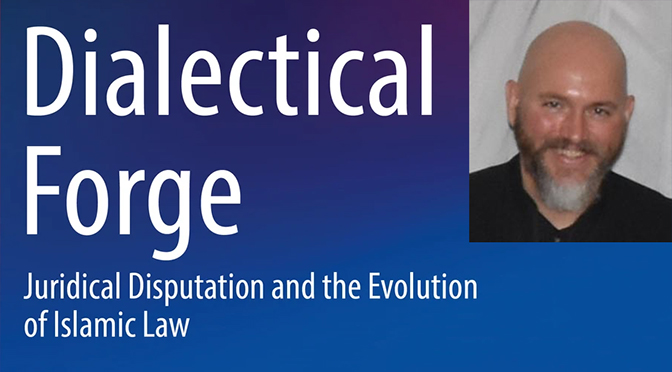
Review of Walter Young, The Dialectical Forge

I was honored to be asked to review Walter Young’s monumental work The Dialectical Forge for Der Islam.

Review of Walter Edward Young, The Dialectical Forge: Juridical Disputation and the Evolution of Islamic Law (Cham, Switzerland: Springer, 2017). Der Islam 102, no. 1 (2025): 326–331.

The published review is available online at De Gruyter Brill.

The prepublication text is available here as a PDF.

Four Contested Choices in the Invention of Islamic Law

I was honored with an invitation to present this paper, “Four Contested Choices in the Invention of a Revealed, Systematic, and Comprehensive Islamic Law,” for the Faculty of Asian and Middle Eastern Studies and Pembroke College, Oxford, on March 13, 2023. It is an improved version of a paper presented in Bad Homburg in July 2022.

The slides are available here as a pdf.


Four Contested Steps in the Emergence of a Revealed, Systematic, and Comprehensive Islamic Law

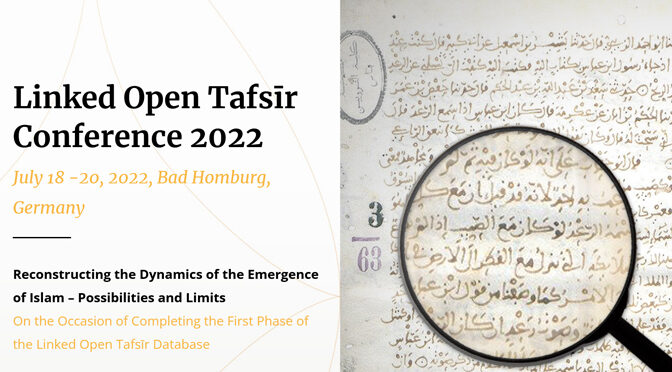
Many thanks to Serdar Kurnaz and his collaborators for inviting me to join the stunning lineup of speakers at the conference celebrating the conclusion of the first phase of their Linked Open Tafsīr project. It was a rich feast, thanks to the wonderful hospitality of our hosts and the full schedule of updates about a wide range of innovative research projects. My paper was:

“Four Contested Steps in the Emergence of a Revealed, Systematic, and Comprehensive Islamic Law.” Linked Open Tafsīr Conference 2022: Reconstructing the Dynamics of the Emergence of Islam — Possibilities and Limits, Bad Homburg, Germany, July 20, 2022.

The slides from my talk are available as a pdf here.

Islamic Law and Ethics

This volume assembles many of the papers delivered at the 2014 Summer Institute for Scholars on “Sharia and Ethics” hosted by the International Institute for Islamic Thought in Herndon, Virginia. Many thanks to Ermin Sinanović for organizing the institute and initiating the volume, to Abdulaziz Sachedina for guiding the selection of papers, and to Shiraz Khan for seeing it through to publication.

David R. Vishanoff, ed. Islamic Law and Ethics. London: International Institute of Islamic Thought, 2020.

The book is Open Access and available in multiple formats including a free PDF from IIIT and on JSTOR. Paperback, hardcover, and Kindle versions may be purchased through amazon.

Abstract

Does Islamic law define Islamic ethics? Or is the law a branch of a broader ethical system? Or is it but one of several independent moral discourses, Islamic and otherwise, competing for Muslims’ allegiance? The essays in this book present a range of answers: some take fiqh as the defining framework for ethics, others insert the law into a broader ethical system, and others present it as just one among several parallel Islamic ethical discourses, or show how Islamic ethics might coexist with non-Muslim normative systems. Their answers have far-reaching implications for epistemology, for the authority of jurists and lay Muslims, for the practical moral challenges of daily life, and for relationships with non-Muslims. The book presents Muslim ethicists with a strategic contemporary choice: should they pursue a single overarching methodology for judging all ethical questions, or should they relish the rhetorical and political competition of alternative but not necessarily incompatible moral discourses?

Contents
  1. The Ethical Structure of Imam al-Haramayn al-Juwayni’s Legal Theory, by David R. Vishanoff
  2. “Neither Desiring It, nor Transgressing Its Limits:” Ethical Hierarchy in Islamic Law, by Samy Ayoub
  3. Structural Ijtihad: A Radical Paradigm Shift in Twelver Shi`i Legal Theory, by Hamid Mavani
  4. The Application of Maqasid al-Shari`ah in Islamic Chaplaincy, by Kamal Abu-Shamsieh
  5. The Developmentalist Ethic in Islamic Charity: Fiqh al-Zakah and the Applied Ethics of Muslim Charity Organizations in India, by Christopher B. Taylor
  6. The Concept of Rida in the Qur’an: Popular Misunderstanding and the Westernization of Jews and Christians, by Asaad Alsaleh
  7. Social Justice and Islamic Legal/Ethical Order: The Madinah Constitution as a Case Study from the Prophetic Period, by Katrin Jomaa

The anthropological turn in Islamic legal interpretation

On July 23-24, 2016, the Zentrum für Islamische Theologie at the University of Tübingen did a superb job of organizing and hosting a conference on “Islamic Theology – Past, Present and Future: Global Challenges and Prospective Synergies in the Academic Study of Islam.” My presentation dealt once again with the Indonesian thinker Aksin Wijaya, arguing that his explicitly anthropocentric epistemology reflects a broader shift in Islamic thought that opens up new conversations between historical and confessional scholarship on Islam:

“The Anthropological Turn in Islamic Legal Interpretation.” Islamic Theology – Past, Present and Future: Global Challenges and Prospective Synergies in the Academic Study of Islam, University of Tübingen, July 24, 2016.

Here is a pdf of the paper, as delivered. It was written for oral presentation, without documentation. I plan to use it as the framework for a published article incorporating aspects of several papers I have given recently on Qur’anic hermeneutics in contemporary Indonesia.