Tag Archives: Islamic legal theory

Guest posts on Harvard’s Islamic Law Blog

The Islamic Law Blog of the Program in Islamic Law at Harvard Law School invited me to serve as their guest editor during November 2019. I contributed posts on teaching, research hacks, a recent conference, and uṣūl al-fiqh:

The blog is relatively new, and already has a long list of great contributors. You might want to subscribe!

Uṣūl al-Fiqh versus Hermeneutics

Detail of wall in the ornate meeting room

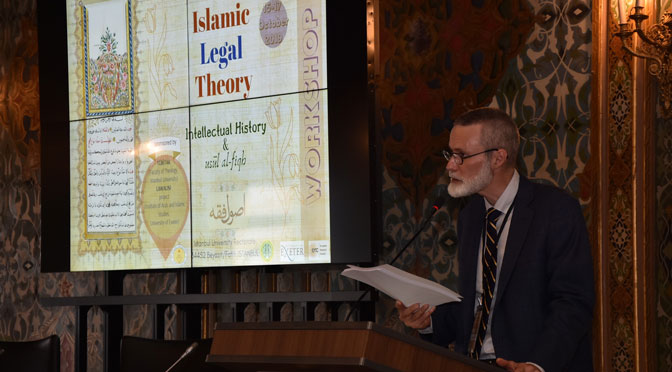
Many thanks to Rob Gleave and Murteza Bedir for organizing another great conference on Islamic legal theory in Istanbul, and to all the participants for rich conversations and for helpful feedback on my paper, which was:

“Uṣūl al-Fiqh versus Hermeneutics: History, Linguistics, Ideology, Phenomenology, and Postmodernism between Europe and Indonesia.” Conference on “Islamic Legal Theory: Intellectual History and Uṣūl al-Fiqh,” Istanbul University, October 15, 2019.

Here is a pdf of the pre-conference draft of the paper that was shared with participants. It is complete but lacks documentation, so please do not cite it formally yet; it has since undergone significant revision and has been submitted for publication in the conference volume, which we hope will be published in 2022.

Conference participants
The conference participants
Detail of wall in the ornate meeting room
View of the Süleymaniye mosque from the meeting room

Indicative and Performative Theories of Divine Speech in Classical Islamic Legal Theory

Nadja Germann and her research team put on a very rich and remarkably focused conference on “Intention and Signification: Philosophy of Language Across Islamic Disciplines, 800-1200” at the University of Freiburg, in beautiful Baden-Württemberg, Germany, from June 1 to 3, 2017. What a feast! My own contribution was:

“Indicative and Performative Theories of Divine Speech in Classical Islamic Legal Theory.” Intention and Signification: Philosophy of Language Across Islamic Disciplines, 800-1200, University of Freiburg, June 3, 2017.

The paper has now been revised and published in the conference volume from De Gruyter.

A Critical Introduction to Islamic Legal Theory (online)

(A revised version of this book is now available here from Hackett.)

After years of ruminating on Islamic legal theory (uṣūl al‑fiqh) I have published online a “textbook” with several unusual features:

  • It is free.
  • Readers can add their own comments to specific paragraphs, arguing with me, al‑Juwaynī, and one another.
  • Like many medieval textbooks, it takes the form of a commentary on a short handbook, Imām al‑Ḥaramayn al‑Juwaynī’s famous Kitāb al‑Waraqāt fī uṣūl al‑fiqh.
  • Its approach is more critical, however. It does not just repeat classical explanations and examples, but asks contemporary questions about epistemology, ideology, and ethics.
  • Consequently, it may hold some interest for specialists as well as students.
  • It is based on a new English translation of the Waraqāt, which is itself based on something surprisingly novel: a critical edition of this oft-republished text.
  • Comments posted by readers will help shape a future print edition.

The book is online at http://waraqat.vishanoff.com, and may be cited as:

David R. Vishanoff. A Critical Introduction to Islamic Legal Theory: A Critical Edition, English Translation, and New Commentary on Imām al‑Ḥaramayn al‑Juwaynī’s Leaflet on the Sources of Law (Kitāb al‑Waraqāt fī uṣūl al‑fiqh). Published online March 3, 2017, at http://waraqat.vishanoff.com.

Please share the link with students and even specialists who might find it useful.

A Reader’s Guide to al-Shāfiʿī’s Epistle on Legal Theory (al-Risāla)

This Reader’s Guide is intended as a companion for those engaged in the delightful but sometimes puzzling task of reading al-Shāfiʿī’s famous Risāla, a work that sparked the discipline of Islamic legal theory. It includes a discussion of the structure of the work and a detailed twenty-four-page analytical outline that spells out step by step the flow of what I take to be al-Shāfiʿī’s argument. I hope it proves a useful tool for students and a compelling interpretive proposal for scholars already familiar with the work.

David R. Vishanoff. “A Reader’s Guide to al-Shāfiʿī’s Epistle on Legal Theory (al-Risāla).” Islam and Christian–Muslim Relations 28 no. 3 (2017): 245-269.

The Version of Record (VoR) is published at http://dx.doi.org/10.1080/09596410.2017.1289705. Please cite only this final version. For scholars whose institutions do not provide access to the journal, a limited number of free downloads are available at http://www.tandfonline.com/eprint/PEsTW46I5pridIR5AxQn/full

A longer version, the Author’s Original (AO), is available here as a pdf for personal schol­ar­ly and educational use. It does not reflect the corrections and additions to the introductory essay that were suggested by reviewers, and therefore should not be cited in scholarship, but it has two advantages for personal study and teaching: it includes a brief as well as a detailed outline of the Risāla, and the long outline retains numerous comments about the text, including suggested amendments to Joseph Lowry’s translation of the Risāla, that had to be cut from the published version.