Classical Islamic Legal Theory and Modern European Philosophy in Conversation: Language, Ethics, History, Politics, and Phenomenology

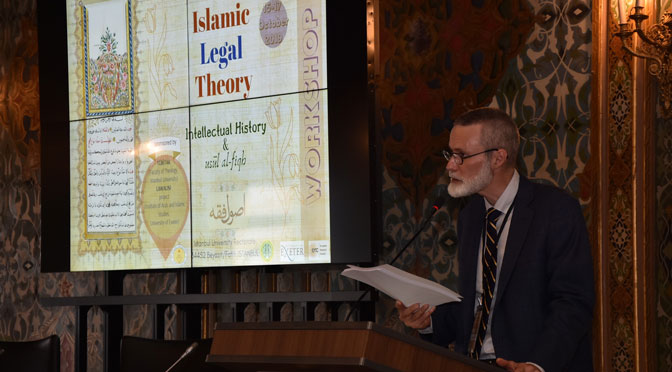
Many thanks to Serdar Kurnaz, his Working Group for Islamic Philosophy of Law, and his team from the Berlin Institute for Islamic Theology, for calling together what turned out to be a creative, imaginative, and wide-ranging conference on “Constructing Islamic Philosophy of Law: Obstacles, Challenges and Solutions.” It was held in the old Veterinary Anatomy Theater (pictured) at Humboldt University in Berlin on May 27-28, 2022. My paper was:

“Classical Islamic Legal Theory and Modern European Philosophy in Conversation: Language, Ethics, History, Politics, and Phenomenology.” Constructing Islamic Philosophy of Law: Obstacles, Challenges and Solutions, Berlin Institute for Islamic Theology, Humboldt University, Berlin, May 27, 2022.

Here is a pdf of the slides for the presentation.

The inside of the Veterinary Anatomy Theater:

Theologies of Divine Speech and the Human Exigencies of Law

Many thanks to Muna Tatari and Idris Nassery for their warm hospitality and engagement during their conference on “Dynamics of Tradition: Islamic Theology and Law in Relation” at the University of Paderborn, September 17-19, 2021. I presented the following paper:

“Theologies of Divine Speech and the Human Exigencies of Law: A Conundrum for Classical and Contemporary Islamic Legal Hermeneutics.” Dynamics of Tradition: Islamic Theology and Law in Relation, Institute for Islamic Theology, University of Paderborn, Germany, September 19, 2021.

Here is a pdf of the pre-conference draft, without documentation, from which I presented excerpts at the conference.

The final paper was published in the conference volume, from Brill, in 2025.

Five Facets of the Anthropological Turn in Qur’anic Hermeneutics

Majid Daneshgar and Johanna Pink, of the University of Freiburg, invited me to participate in their online lecture series “Freiburg conversations on tafsir and transregional Islamic networks II,” and Nadja Germann, also of the University of Freiburg, served as host and gave a very helpful and thought-provoking response that will reshape the outline of my long-term project on contemporary Qur’anic hermeneutics. Questions from the audience, starting with Karen Bauer, are also pushing me to rethink my starting point: should I start with the classical and modern sources of hermeneutical ideas, or with the thinkers who appeal to those classical and modern sources, or with the ideas themselves? Should I work chronologically or thematically? Up or down the isnads of intellectual transmission and exchange? The discussion really got me thinking.

“Five Facets of the Anthropological Turn in Qur’anic Hermeneutics: History, Linguistics, Ideology, Phenomenology, and Postmodernism.” Freiburg conversations on tafsir and transregional Islamic networks II, via Zoom, March 3, 2021.

There were no slides, but the full text of the talk is available here as a pdf. Video of both the talk and Nadja’s response (but not the Q&A) is available on YouTube here.

Uṣūl al-Fiqh versus Hermeneutics

Detail of wall in the ornate meeting room

Many thanks to Rob Gleave and Murteza Bedir for organizing another great conference on Islamic legal theory in Istanbul, and to all the participants for rich conversations and for helpful feedback on my paper, which was:

“Uṣūl al-Fiqh versus Hermeneutics: History, Linguistics, Ideology, Phenomenology, and Postmodernism between Europe and Indonesia.” Conference on “Islamic Legal Theory: Intellectual History and Uṣūl al-Fiqh,” Istanbul University, October 15, 2019.

Here is a pdf of the pre-conference draft of the paper that was shared with participants. It is complete but lacks documentation, so please do not cite it formally yet; it has since undergone significant revision and has been submitted for publication in the conference volume, which we hope will be published in 2022.

Conference participants
The conference participants
Detail of wall in the ornate meeting room
View of the Süleymaniye mosque from the meeting room

Sacrificial Listening: An Epistemology and Pedagogy for Intellectual Humility in the Humanities

This paper attempted to articulate in a more detailed and systematic way the notion of “sacrificial listening” that is the guiding principle of my research and teaching. Its main points were presented to a group of colleagues in philosophy, psychology, education, and other fields at the University of Oklahoma, as part of the Virtue Forum Luncheon series of the Institute for the Study of Human Flourishing. Many thanks to Institute director Nancy Snow for this great chance to get some interdisciplinary input on this long-term project, and to the audience for a very helpful discussion.

“Sacrificial Listening: An Epistemology and Pedagogy for Intellectual Humility in the Humanities.” Virtue Forum Luncheon series of the Self, Virtue and Public Life Project, Institute for the Study of Human Flourishing, University of Oklahoma, October 9, 2019.

Here is a pdf of the full paper. A more developed version has since been published as An Epistemology for Listening Across Religious, Cultural, and Political Divides.