All posts by David Vishanoff

On the Integration of Faith, Epistemology, and Vocation

The Harvey Fellowship, which helped and encouraged me through graduate school, celebrated its thirtieth anniversary with a conference on integrating Christian faith and professional vocation, held at American University in Washington, DC, June 23-25, 2023. My paper was:

“Incarnation, Crucifixion, Resurrection: On the Integration of Faith, Epistemology, and Vocation.” Harvey Fellows Conference on Integrating Faith & Vocation, Washington, DC, June 24, 2023.

Here is a pdf of the paper as presented.

Many thanks to Kristen Gustavson, Phyllis Stevenson, Olivia Mather, and Caleb Spencer for this rich and nourishing time, full of new friendships and needed reflection.

Methods and Motives for Mapping Complex Families of Manuscripts

At the 2023 British Association for Islamic Studies conference I  presented the mix of traditional stemmatic and digital methods I used to reconstruct the original core text of the Islamic Psalms of David:

“The Afterlife of an Ascetic Pseudo-Scripture: Methods and Motives for Mapping Complex Families of Manuscripts.” British Association for Islamic Studies, Institute for the Study of Muslim Civilisations, London, May 16, 2023.

My slides are available as a pdf here.

Four Contested Choices in the Invention of Islamic Law

I was honored with an invitation to present this paper, “Four Contested Choices in the Invention of a Revealed, Systematic, and Comprehensive Islamic Law,” for the Faculty of Asian and Middle Eastern Studies and Pembroke College, Oxford, on March 13, 2023. It is an improved version of a paper presented in Bad Homburg in July 2022.

The slides are available here as a pdf.


An Epistemology for Listening Across Religious, Cultural, and Political Divides

This essay is my first systematic published articulation of my theory of Sacrificial Listening. Many thanks to Mike Berhow and Greg Peterson of South Dakota State University for giving me a chance to sketch out some of my ideas there during a rich conversation in 2016, and for subsequently welcoming this more developed essay into their volume on the importance of intellectual virtues in a polarized society:

“An Epistemology for Listening Across Religious, Cultural, and Political Divides.” In Engaging Populism: Democracy and the Intellectual Virtues, ed. Gregory R. Peterson, Michael C. Berhow, and George Tsakiridis, 185–214. [London]: Palgrave Macmillan, 2022.

This essay stems from two decades of reflection on my scholarship and teaching in the field of Islamic studies. That thinking was first articulated somewhat autobiographically, with a focus on pedagogy, in a paper called “Sacrificial Listening: Christians, Muslims, and the Secular University.” It was fleshed out more systematically in a talk at the University of Oklahoma, “Sacrificial Listening: An Epistemology and Pedagogy for Intellectual Humility in the Humanities.” In this published chapter I attempt to sharpen its philosophical grounding, frame it in terms of intellectual virtues, and broaden its application to include the understanding of Others across political lines.

The published essay and the entire volume are available from Palgrave Macmillan at https://doi.org/10.1007/978-3-031-05785-4. Here I am only able to post my Author’s Original preprint manuscript as a pdf file.

Four Contested Steps in the Emergence of a Revealed, Systematic, and Comprehensive Islamic Law

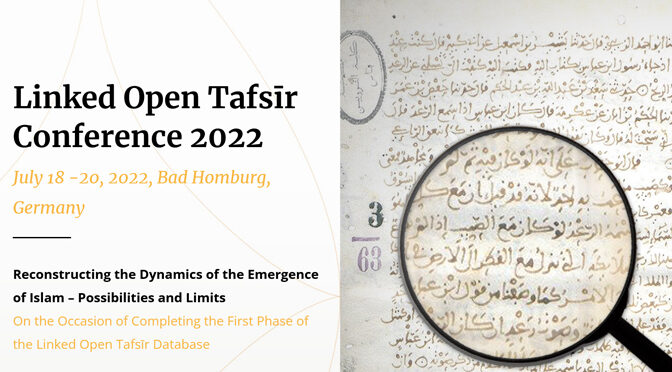
Many thanks to Serdar Kurnaz and his collaborators for inviting me to join the stunning lineup of speakers at the conference celebrating the conclusion of the first phase of their Linked Open Tafsīr project. It was a rich feast, thanks to the wonderful hospitality of our hosts and the full schedule of updates about a wide range of innovative research projects. My paper was:

“Four Contested Steps in the Emergence of a Revealed, Systematic, and Comprehensive Islamic Law.” Linked Open Tafsīr Conference 2022: Reconstructing the Dynamics of the Emergence of Islam — Possibilities and Limits, Bad Homburg, Germany, July 20, 2022.

The slides from my talk are available as a pdf here.