
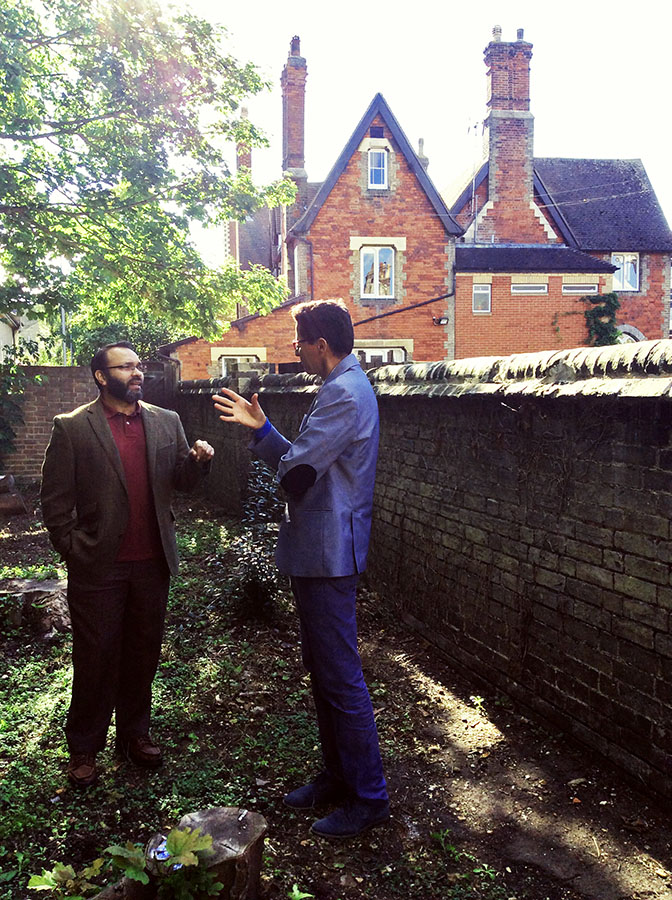
Harith Bin Ramli and Ramon Harvey hosted a warm, lively, and coherent symposium on theologies of revelation at the Cambridge Muslim College. It was a beautiful and memorable day, epitomized by this image of Shahrur and Mohammed:
My presentation was a reflective pause, looking back on my previous work on classical legal hermeneutics, drawing in my recent readings in Indonesian Qur’anic hermeneutics, and pondering some of the intellectual challenges and moral dangers of thinking systematically about revelation:
“Can Qur’anic Interpretation Be both Practically Adequate and Theologically Principled? Some Instructive Historical Examples of the Delicate Connection between Hermeneutical Theories and Doctrines of Divine Speech.” From Revelation to Scripture: A Symposium on Divine Speech and Prophetic Inspiration in Islam, Cambridge Muslim College, Cambridge, England, September 12, 2015.
The new material in this paper about the Indonesian thinker Aksin Wijaya was previously discussed at the International Qur’anic Studies Association in 2014. This paper was not published, but a revised and expanded version will be presented at a conference on “Dynamics of Tradition: Islamic Theology and Law in Relation” at the University of Paderborn, September 19, 2021, and will hopefully be published in a volume of essays from that conference.
Another image from the day–Farrokh and Ramon during one of the many coffee breaks:

Many thanks to Khalil Andani for pointing out to me a passage in `Abd al-Jabbar’s Mughni (vol. 7 p. 80) where he says that God’s speech is created in history, after the events that it narrates in the past tense.
This means I was wrong when I said, on page 4 of this paper, that according to `Abd al-Jabbar “every word of God’s speech was created all at once, not in seventh-century Arabia but on the Heavenly Tablet, long before any of it was ever sent down into the specific historical circumstances of a particular prophet. None of God’s speech was uttered in a historical context.”
Those who say that “the Muʿtazilī doctrine of God’s created speech makes the Qurʾān a historical document” appear to be right!